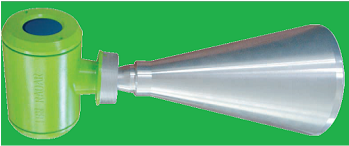
What does it do?
Measures a distance (and target velocity) providing analog 4-20mA output (2 relays, digital serial port I/O and quadrature pulse output available).
Suitable in general non-contact distance, level or object intrusion detection requiring fast response time,2.5cm accuracy and narrow beam spread angle (4 degree, 75mm diameter of a lense-horn antenna). It can be used in partially obstructed applications, through narrow openings, or through microwave-transparent windows (plastic, ceramic, 6mm glass, 2.5cm wood etc ). Standard range is 0.5-50m with 75mm antenna (long range with larger antenna) . Works through rain, snow, dust etc. Tolerates dusty environment, moisture splashes on the lense and environmental temperature variations.
How does it work?Emitting, receiving and processing frequency modulated (FMCW) microwave signal at 77GHz (50mW). Can be re-tuned for 62 or 122GHz ISM bands. Bult-in microprocessor performs FFT and proprietary signal analysis.
Interface and wiring (3 or 4 wire device):
*
Analog output 4-20mA current loop (linked as isolated sink or 3 wire
sourcing),
Additional software: Text
terminal emulator with graphics capability to communicate with the
device, configuration and data display: Firmware:
*
Quadrature pulse output mimicking rotary pulse encoders (5 or 24V),
*
Digital serial data port (use generic ASCII terminal program or VelTerm.exe
application for WinXP)
(Note: serial-to-USB, Bluetooth or Ethernet gateways should be used for
longer distances).
- Download VelTermSetup.zip (full setup installation 3MB)
- Download "FastRanger" firmware update (zipped .mot file, use Renesas programming tool for M16C/62P-M30626FHP)
Communication with the radar device and screen shots from VelTerm.exe: - open parameter configuration screen - display results (autorepeat every 2 seconds) - display history file (graphic plot) - display FFT spectrum - display FFT with autorepeat every 2 seconds - display raw signal plot in time ("oscilloscope") - display frequency modulation ramp profile Configuration Screen 
Note: the above graph represents stability test results. Data was logged in the sensor (Unit #27) over 7 days from a fixed target (steel plate 35X43cm) at 30m distance . Stability of the output was 0.3% (standard deviation), max-min spread 0.9% (900 data points excluding the 72-nd hour). Time "0" date was 26-Aug-2008, 3PM. The sensor was configured with no temperature compensation. Temperature range was 16-33C as measured on the circuit board (with no enclosure). The actual air temperature was 8 degrees lower. The target was disturbed by strong wind and had to be re-aimed at 72-nd hour.
Scope screen: raw signal versus time (different situation from the above two plots).
28-Aug-2008
Unit 27: Photograph: radar setup (75mm
lens-horn) and a small perpendicular steel target plate 35X43cm, at 30m (approximately).
The setup was partially
shielded from rain (under a deck) but exposed to variation of
environmental factors for 7 days. Resulting history file is
shown on one of the previous pictures (History plot).
Linearity test.

Unit 20: linearity curve, planar target
(partition wall).

Unit 20: linearity test, deviations plot, using planar target 1.8X1.8M (office partition wall).

Unit 20: linearity test results, irregular
target using plastic pellets (3mm size). The sensor was hung on a rope above a 3x3m square skip filled
with plastic pellets (size about 3mm). The surface was irregular with waves and groves ~30cm high

Unit 21: linearity test results, planar target
(partition wall).

Photo of the working prototype Rev.2.

Power spectrum graph downloaded through serial/USB link, displayed using VelTerm.exe program. Averaging accumulation length = 8 (repetitions). Estimated (extrapolated) maximal range: 120ft (with 1" horn antena). Estimated maximal range for the same target using 3" lens-horn antena: ~360ft (110m). Estimated distance measurement resolution: +/- 1cm (software dependent).
Target view (click photo for higher res.) / Prototype radar unit view.

3 hour stability test,
history data log using target plate 13"x17" at 100ft. 10s data
logging interval. Results: standard
deviation 5.24mm, average reading 31.24m.
Contacts:
Stan
Bleszynski,
R.R.
1
Lakefield,
1668
Lakehurst
Rd. (Buckhorn),
K0L
2H0
Ontario Canada
+1-705-6572419
stanb
(a.t) velsensor.com
stanb
(a.t) ptbo.igs.net
Other products and services by Stan
Bleszynski:
http://www.ptbo.igs.net/~stanb/
Ultraducer
Resume
(English)
Resume
(Chinese
Mandarin)